



Insurance coverage for specialized infusion services varies by insurance plan and therapy type. The prescribed treatment and whether care takes place at home or in an infusion suite can also affect coverage. Understanding these factors can help you know what to discuss before treatment.
It’s reasonable to want clear information before planning treatment, especially when care involves ongoing infusions or a complex condition. This article explains the differences between home infusion and infusion suites, what can influence coverage, and how the care setting relates to your clinical needs.
You’ll also learn what specialized infusion care can involve, which therapies may be provided in these settings, and what to discuss with your treatment team. The goal is to make your options clearer and help you prepare for the next conversation.
Key Takeaways
- Understand how infusion care is administered and which healthcare professionals may be involved in coordinating treatment.
- Learn which plan and treatment details can affect insurance coverage and your potential out-of-pocket expenses.
- Compare home infusion with infusion suites to consider which care setting may better fit your treatment needs.
- Explore the conditions treated with infusion therapy and the questions that can help you understand your care options.
What Is Home Infusion?
Home infusion delivers prescribed medication or fluids through an IV or injection outside a hospital. The care plan may involve nurses, physicians, and other healthcare professionals.
Ambulatory IV and Injectable Care
Ambulatory infusion provides IV medication or injections without an overnight hospital stay. An IV delivers medication or fluid directly into a vein, where it is rapidly absorbed. Subcutaneous injections place medication beneath the skin, while intramuscular injections deliver it into large muscles. These routes have slower and moderate absorption, respectively. Vaccines and pain relief are common intramuscular uses; insulin management and biologics are subcutaneous examples. Consider the prescribed route, the administration steps, and whether care takes place at home or in a clinic. Nurses can explain the practical steps for the selected treatment.
Coordination With Local Physicians
Local physicians connect infusion treatment with a patient’s diagnosis, medication plan, and follow-up care. A coordinated plan clarifies who manages each step, how treatment information is shared, and whom to contact about changes. Nurses administer infusion care and monitor patients during treatment. An infusion nurse must have an Associate’s Degree in Nursing or a Bachelor of Science in Nursing and pass the NCLEX-RN exam. The nurse must also gain at least 1,600 hours of experience in an infusion-related field. For future planning, patients and care teams can review the treatment route, setting, and follow-up needs together.
Treated Conditions and Safety Risks
Infusion therapy may be prescribed for acute or chronic conditions. Examples include intravenous treatment for dehydration and chemotherapy delivered through an IV. The treatment plan guides the setting and monitoring. Possible side effects include discomfort at the injection site, allergic reactions, or other medication-specific reactions. Tell your care team about symptoms during or after treatment so they can assess them in context. Before an infusion begins, ask about the medication, route, and monitoring plan.
Are infusions covered by insurance?
Coverage varies by insurance plan and therapy type. Your prescribed treatment and care setting can also affect how costs are handled. Reviewing your benefits can help clarify potential out-of-pocket expenses.
Coverage and Patient Costs
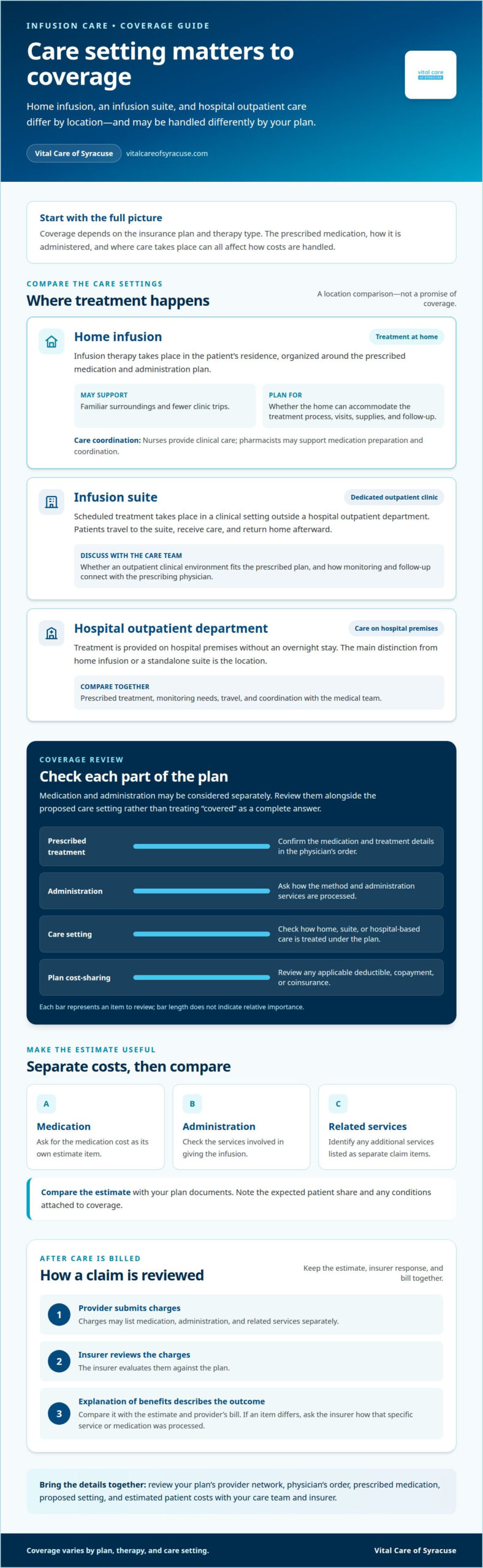
For intravenous treatment, coverage can depend on the medication, administration, and care setting. A hospital visit and home infusion may be processed differently under the same plan. Review your benefits for the treatment and site of care, including any applicable deductible, copayment, or coinsurance. These plan terms help explain which costs may remain your responsibility.
Ask for an estimate that separates medication, administration, and related services. These may appear as separate claim items. Compare the estimate with your plan documents, and note the expected patient share and any conditions attached to coverage. This helps you plan without assuming every infusion has the same cost.
Insurance Acceptance
A provider’s ability to work with your insurance plan does not determine whether a specific treatment is covered. Review the plan’s provider network, prescribed medication, and proposed care setting. A physician’s order and treatment details help identify what the plan will evaluate. Keep the insurer’s explanation of benefits with your estimate for comparison.
Coverage decisions may treat the medication separately from the place or method of administration. Review these elements together rather than treating “covered” as a complete answer. A plan may apply different cost-sharing rules to hospital-based and home-based care.
At an infusion appointment, staff review the treatment plan and medication before preparing the prescribed infusion. Licensed clinicians administer treatment and monitor the patient according to established protocols. Bring your insurance information and physician’s instructions, and share relevant changes in your health or medications.
Claims processing generally follows this sequence: the provider submits charges, the insurer reviews them against the plan, and an explanation of benefits describes the outcome. Compare that document with the estimate and provider’s bill. If an item differs, identify the specific service or medication and ask the insurer how it was processed. Keep the response with the related paperwork.
If home-based treatment is part of your plan, explore home infusion care as one setting to discuss with your physician and insurer.
Home infusion and infusion suites
Home infusion takes place in a patient’s residence, while an infusion suite provides outpatient treatment in a dedicated clinical setting. A hospital outpatient department also provides care without an overnight stay, but on hospital premises. The key comparison is where treatment happens and how each setting supports the prescribed care plan.
At home, patients receive infusion therapy in familiar surroundings, with care organized around the prescribed medication and administration plan. For example, a patient receiving a recurring treatment can discuss how visits, supplies, and follow-up fit daily routines. Home care reduces clinic travel, while the patient’s home needs to accommodate the treatment process. Nurses provide clinical care, and pharmacists may support medication preparation and coordination.
An infusion suite provides a clinical setting for scheduled treatment outside a hospital outpatient department. Patients travel to the suite, receive care there, and return home afterward. This may suit someone who prefers treatment outside the home or whose plan calls for an outpatient clinical environment. Ask how monitoring and follow-up connect with the prescribing physician.
A hospital outpatient department is another setting for infusion care. Compared with a standalone suite or home infusion, the main distinction is the location. The prescribed treatment, monitoring needs, travel, and coordination with the medical team all matter when comparing settings. Discuss the options in light of the treatment plan, not convenience alone.
To compare options, note the medication route, appointment setting, monitoring plan, and follow-up contact. Discuss these points with the physician and infusion team. Ask how nurses and pharmacists support the specific treatment and how information is shared with your care team. These practical details help clarify what each setting involves.
Safety outcomes for home infusion are comparable to traditional hospital settings. More than 95% of patients receiving home infusion therapy experience minimal adverse reactions. These figures offer context, but the individual treatment plan still determines the relevant monitoring and support needs.
What conditions are treated with specialized infusion therapy?
Specialized infusion services can support treatment for acute and chronic conditions. The prescribed medication, route, and monitoring plan depend on the condition and the patient’s care needs. A physician identifies the treatment goal and coordinates the infusion plan with the care team.
Some intravenous treatments address dehydration, while chemotherapy is another use of infusion therapy. Cancer infusion care may involve medication administered through an IV as part of a broader treatment plan. The care team considers the prescribed therapy, setting, and monitoring needs when arranging treatment. Ask what the infusion is intended to treat and how it fits your overall plan.
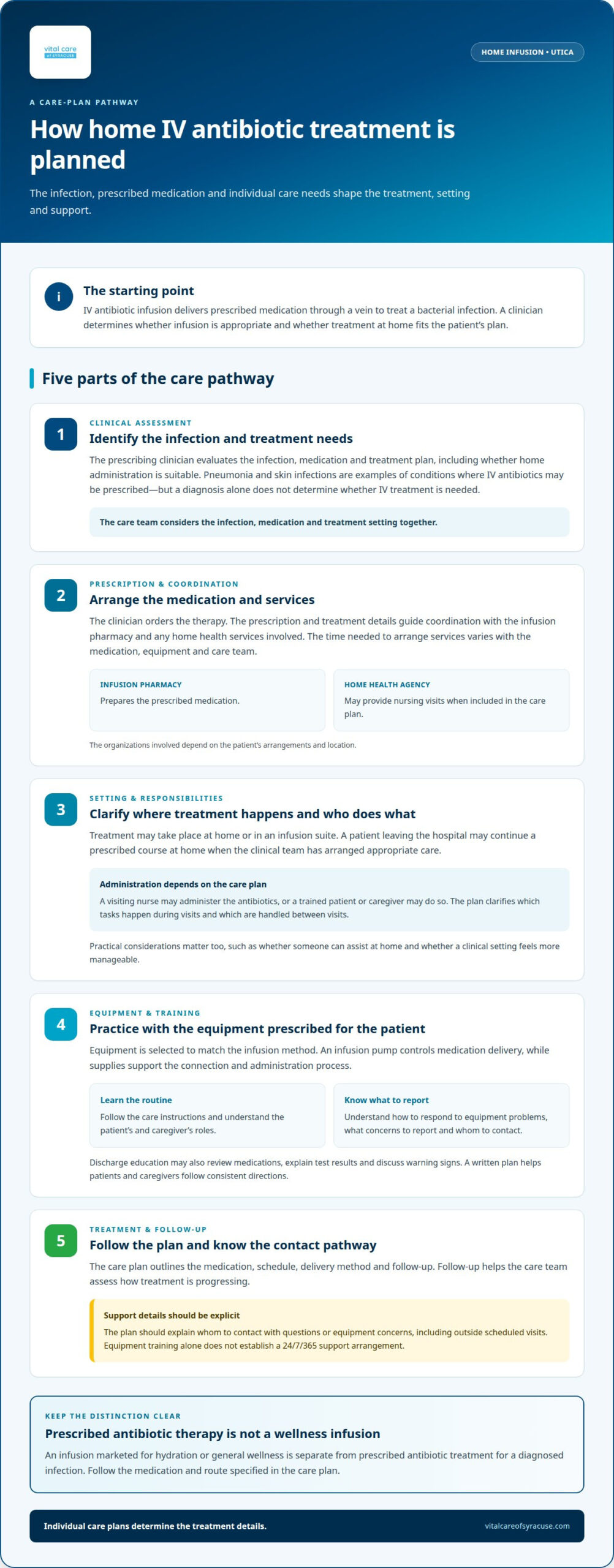
Infections requiring medication delivered by infusion are another treatment area. Anti-infective therapy addresses infections, with the medication and schedule guided by the clinical plan. The physician and infusion team coordinate treatment details, including how care is provided and how progress is followed. Keep an up-to-date medication list so the team understands your treatment.
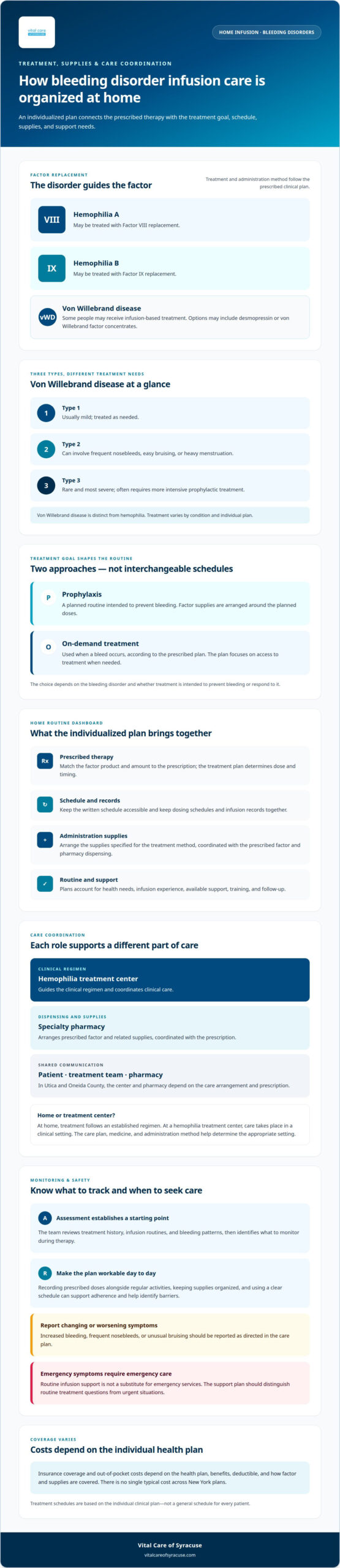
Bleeding disorders, including hemophilia, may also involve infusion therapy. Inotropic therapy can support people with heart failure, while alpha-1 antitrypsin deficiency is another condition addressed through specialized treatment. These examples involve distinct clinical needs, so the therapy and administration plan are not interchangeable. The physician’s diagnosis and treatment goals shape the approach.
To understand whether infusion treatment relates to a particular condition, start with the prescribed medication and its purpose. Ask the physician which condition it addresses, how it will be administered, and what follow-up the plan includes. For example, treatment for an infection differs in purpose and medication from chemotherapy, even if both use an IV. The care team can explain the monitoring plan and each clinician’s role.
Explore infusion care for complex conditions and discuss how a prescribed therapy can fit into your treatment plan.
Vital Care of Syracuse: Anti-infective Therapy
Vital Care of Syracuse provides Anti-infective Therapy when a prescribed treatment calls for infusion care. This service may be relevant when a physician has identified an infection and prescribed infusion therapy. The appropriate medication and treatment plan depend on the patient’s clinical needs.
Vital Care of Syracuse also provides Immunoglobulin (IVIG/SCIG), Parenteral Nutrition (TPN), and Hemophilia and Bleeding Disorder Therapy. These services address different care needs, so the prescribed treatment determines which may be relevant. Sharing your physician’s treatment instructions can help focus the discussion on the therapy being considered.
If you’re considering infusion support for a prescribed treatment, contact Vital Care of Syracuse to discuss its services and your next steps.
Take the Next Step With a Clear Care Plan
Choosing specialized infusion services involves more than selecting a location. It is also an opportunity to make your care plan easier to understand and coordinate. Before your next discussion, note what matters most, such as where treatment takes place, how it fits your routine, and what information your care team needs.
A focused conversation can connect your prescribed therapy with practical details, including your preferred setting and insurance questions. Bring those questions to the people involved in your care so the next steps feel more organized. Vital Care of Syracuse can discuss its infusion services in relation to your treatment needs.
Contact Vital Care of Syracuse to begin a conversation about your care options. A thoughtful next step can help you approach treatment with greater clarity and confidence.
Frequently Asked Questions
How does each type function?
Each route delivers treatment differently. Intravenous medication enters a vein, intramuscular medication goes into a large muscle, and subcutaneous medication is placed beneath the skin. The prescribed medication and care plan determine the route. For example, a clinician may use an IV for prescribed fluids, while some biologics are given subcutaneously.
What options are available for specialized infusion care?
Depending on the prescription and clinical considerations, infusion care may take place at home or in an infusion suite. Vital Care of Syracuse provides Anti-infective Therapy, Immunoglobulin (IVIG/SCIG), Parenteral Nutrition (TPN), and Hemophilia and Bleeding Disorder Therapy. Its local service focus includes Syracuse, Albany, Rochester, Utica, Buffalo, Auburn, and Binghampton. A physician’s treatment plan helps determine which option is relevant.
What are specialized infusion services?
Infusion therapy delivers prescribed medication or nutrition through an IV or injection for acute or chronic health needs. Examples include anti-infective treatment, immunoglobulin therapy, and parenteral nutrition. The medication, route, and care setting depend on the condition and clinical plan. Treatment may take place at home or in an infusion suite when clinically appropriate and under professional supervision.
How do patients get referred and begin treatment?
Patients generally begin by discussing treatment needs with their healthcare provider. Eligibility depends on the prescribed medication, diagnosis, and clinical considerations determined by that provider. The prescription and treatment details help the infusion team coordinate with the physician, nurses, and pharmacists. To begin, prepare current medication information and ask how the proposed therapy fits your care plan.
What does specialized infusion therapy cost in the United States?
There is no single cost for infusion therapy in the United States, and Vital Care of Syracuse publishes no fixed prices. Your out-of-pocket amount depends on the prescribed therapy and insurance benefits, including applicable cost-sharing. Vital Care of Syracuse assists with insurance verification, prior authorizations, and reimbursement coordination. These steps can help clarify how your plan applies before treatment proceeds.
Does Medicare or private insurance cover infusion care?
Coverage varies by insurance plan and therapy type, so Medicare and private insurance do not have one universal answer for every treatment. The prescribed medication and care setting are useful details during a coverage review. Vital Care of Syracuse assists with insurance verification and prior authorizations. Review your plan’s explanation of benefits to understand how a processed claim applies to your coverage.
Leave a Reply