


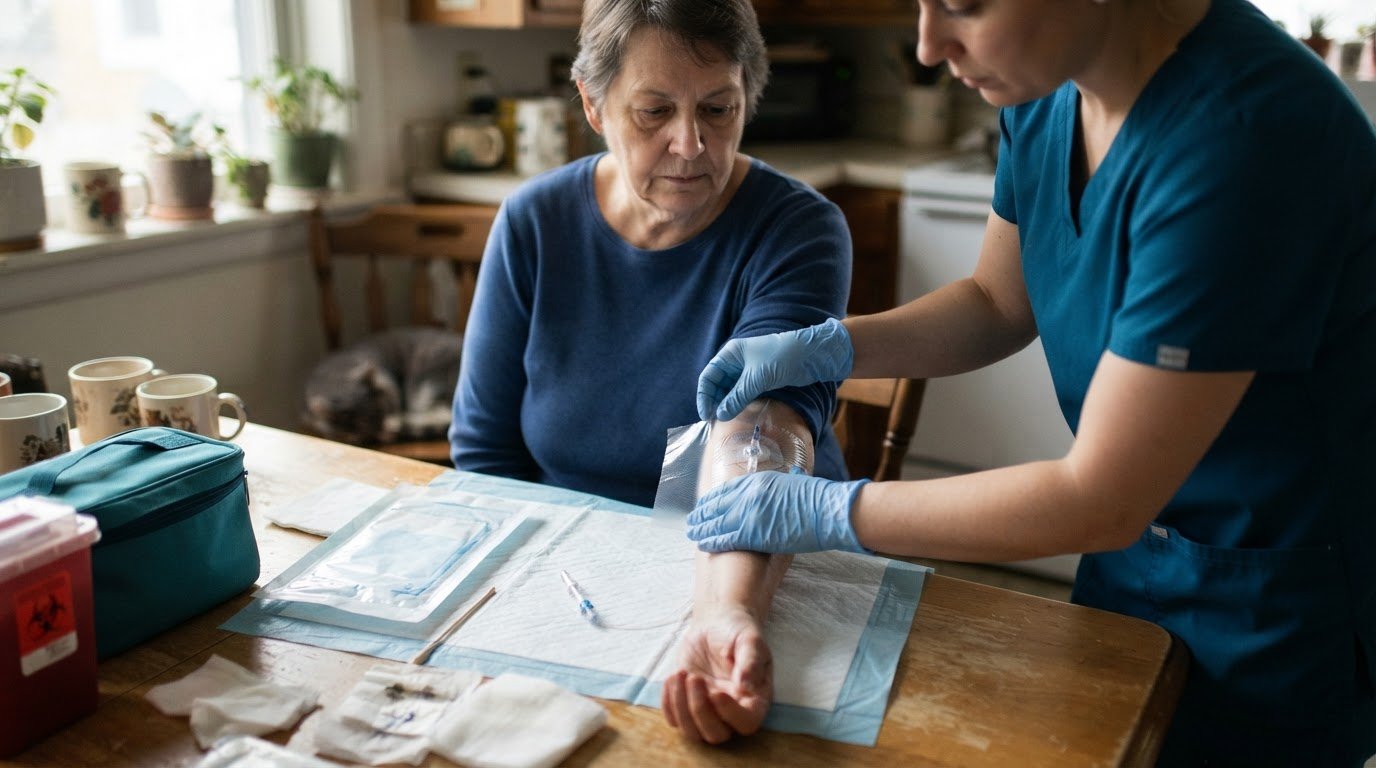
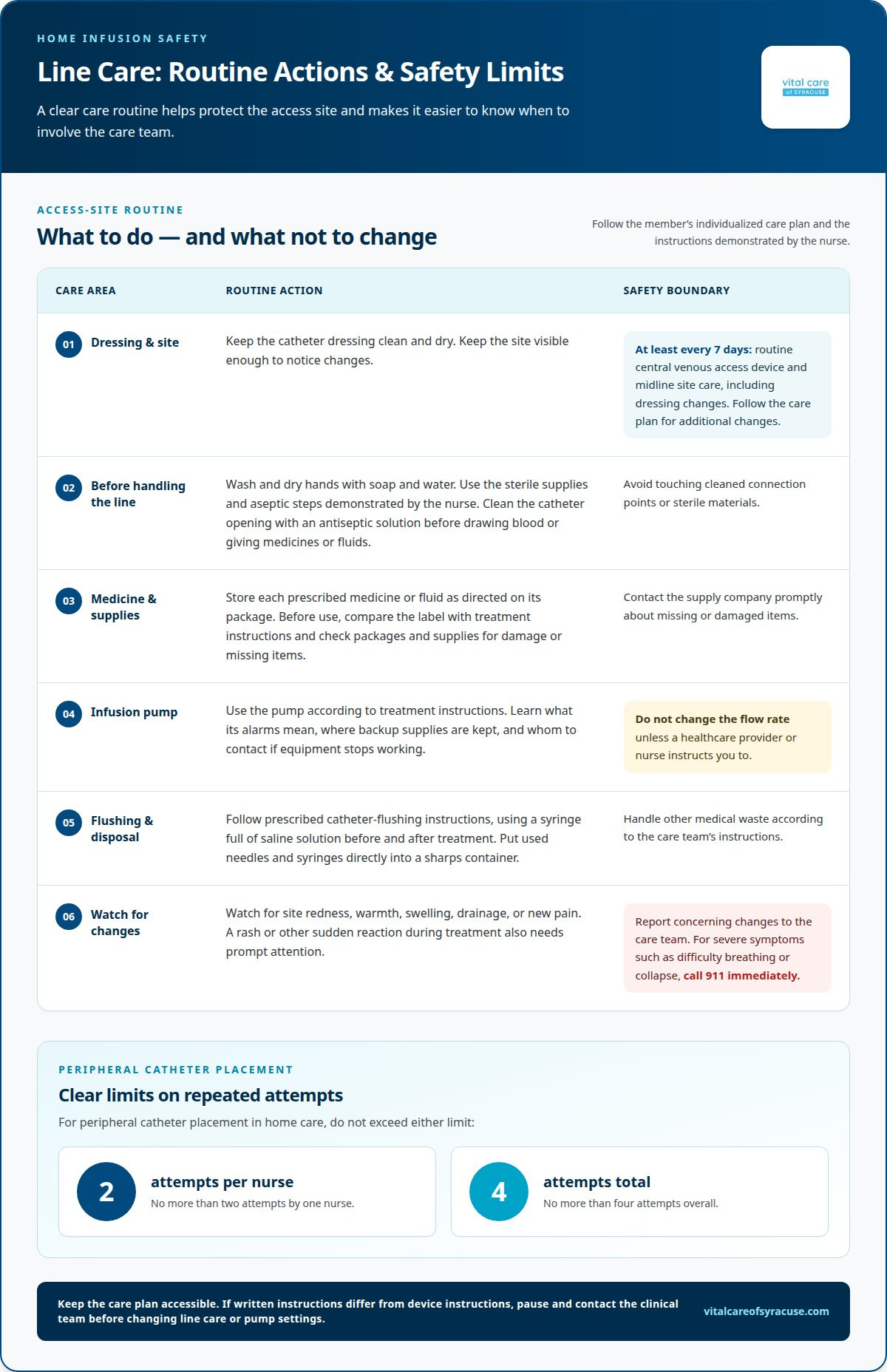
A safe home infusion routine depends on consistent line care and clear limits on repeated attempts. This home infusion safety checklist starts with the basics: keep the catheter’s sterile dressing clean and dry, complete routine central venous access device and midline site care and dressing changes at least every 7 days, and clean the catheter opening with an antiseptic solution before use. For peripheral catheter placement in home care, the recommended limit is no more than two attempts per nurse and no more than four attempts total.
It’s understandable to want practical steps that protect the infusion site and make treatment at home feel manageable. A clear routine helps patients and caregivers know what to look for, what to do, and when to involve the care team.
In the sections ahead, you’ll learn how to assess whether home infusion is suitable, care for access sites, limit venipuncture, and coordinate clinical, medication, scheduling, and equipment information. The checklist also highlights how to keep instructions and responsibilities clear, so patients and caregivers can follow the care plan with greater confidence.
Key Takeaways
- Assess whether the home setting, treatment routine, and available support can meet the patient’s infusion needs.
- Keep the access site clean and dry, and follow the care plan for dressing changes and catheter handling.
- Use clear limits for peripheral catheter attempts to avoid unnecessary repeated venipuncture.
- Coordinate medication, scheduling, equipment, and changes in condition with the care team so everyone understands the plan.
Central venous access and midline dressing care
Keep the member’s catheter dressing clean and dry to help reduce infection risk. Routine central venous access device and midline site care, including dressing changes, should happen at least every 7 days. Follow the care plan for any additional changes, and keep the site visible enough to notice changes.
Before handling the line, wash and dry your hands with soap and water. Use the sterile supplies and aseptic steps demonstrated by the nurse. Avoid touching cleaned connection points or sterile materials. Clean the catheter opening with an antiseptic solution before drawing blood or giving medicines or fluids.
Store each prescribed medicine or fluid as directed on its package. Before use, compare the label with the treatment instructions, and check the package and supplies for damage or missing items. Contact the supply company promptly about missing or damaged items.
Use the infusion pump according to the instructions for the treatment. Learn what its alarms mean, where backup supplies are kept, and whom to contact if the equipment stops working. Don’t change the pump’s flow rate unless a healthcare provider or nurse instructs you to.
Follow the prescribed catheter-flushing instructions, using a syringe full of saline solution before and after treatment. Put used needles and syringes directly into a sharps container to reduce puncture and infection risks. Handle other medical waste according to the care team’s instructions.
Watch for site redness, warmth, swelling, drainage, or new pain, and report concerning changes to the care team. A rash or other sudden reaction during treatment also needs prompt attention. For severe symptoms, such as difficulty breathing or collapse, call 911 immediately.
Use these steps as part of a home infusion safety checklist, alongside the member’s individualized instructions. If the written plan differs from the device instructions, pause and contact the clinical team before changing line care or pump settings.
Interprofessional communication and collaboration
Keep one current care plan accessible to the member, caregiver, nurse, pharmacist, and prescriber. Record the medication name, dose, timing, administration instructions, allergies, and recent changes. Include the care team’s contact details and clarify who handles clinical, scheduling, medication, and equipment concerns. This shared record can reduce confusion when treatment moves from hospital to home.
Call the home infusion nurse, pharmacist, or doctor when the member’s condition changes, instructions conflict, a dose is missed or delayed, or medication questions arise. Contact the appropriate team member promptly about pump problems, supply concerns, or a treatment schedule that cannot be followed. For a medical emergency, call 911 rather than waiting for a routine callback.
Agree on how updates will reach everyone involved. For example, document a new symptom, when it began, and any related treatment change, then share that information with the clinical team. Confirm who will communicate revised instructions to the member and caregiver. Clear documentation helps prevent team members from relying on outdated directions.
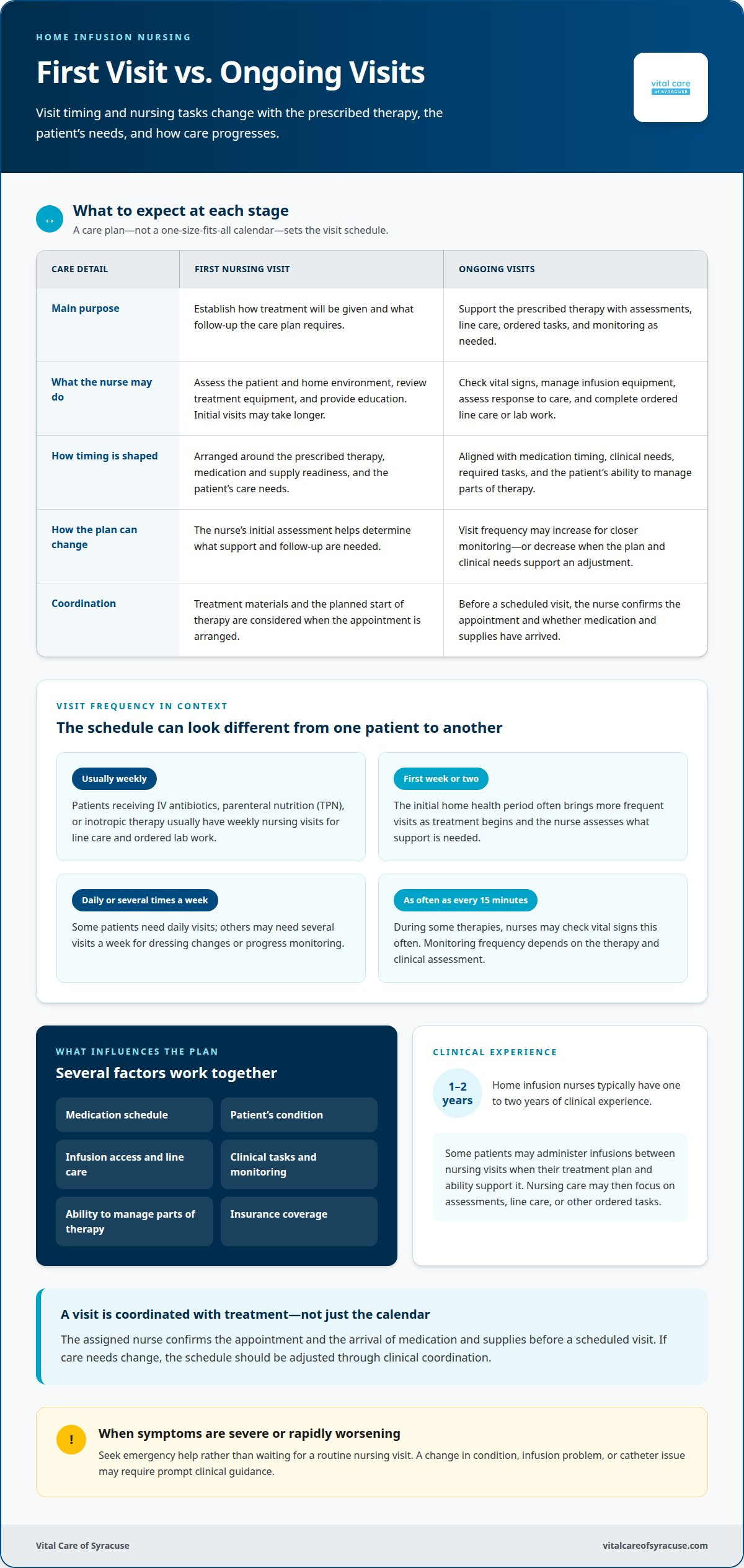
Scheduling can be adjusted to make a prescribed plan workable at home. For example, an antibiotic ordered every 12 hours might be scheduled at 8 am and 8 pm, rather than the hospital’s 5 am and 5 pm timing. The care team coordinates the change while preserving the prescribed interval.
During a hospital-to-home transition, coordinate the medication, pump, supplies, and first home dose before discharge. Antimicrobial treatment should begin with the next scheduled dose, with adjustments for a practical home schedule. If a continuous infusion cannot be interrupted, the pump and medication can be delivered to the hospital for conversion before departure.
- Clinical: Share changes in condition and document care-plan updates.
- Medication: Confirm dose timing, instructions, and changes.
- Equipment: Report device alarms or failures to the designated contact.
- Scheduling: Communicate delays or transition plans promptly.
For coordinated home infusion support, keep the care team’s roles and contact pathway clear.
Patient selection and assessment
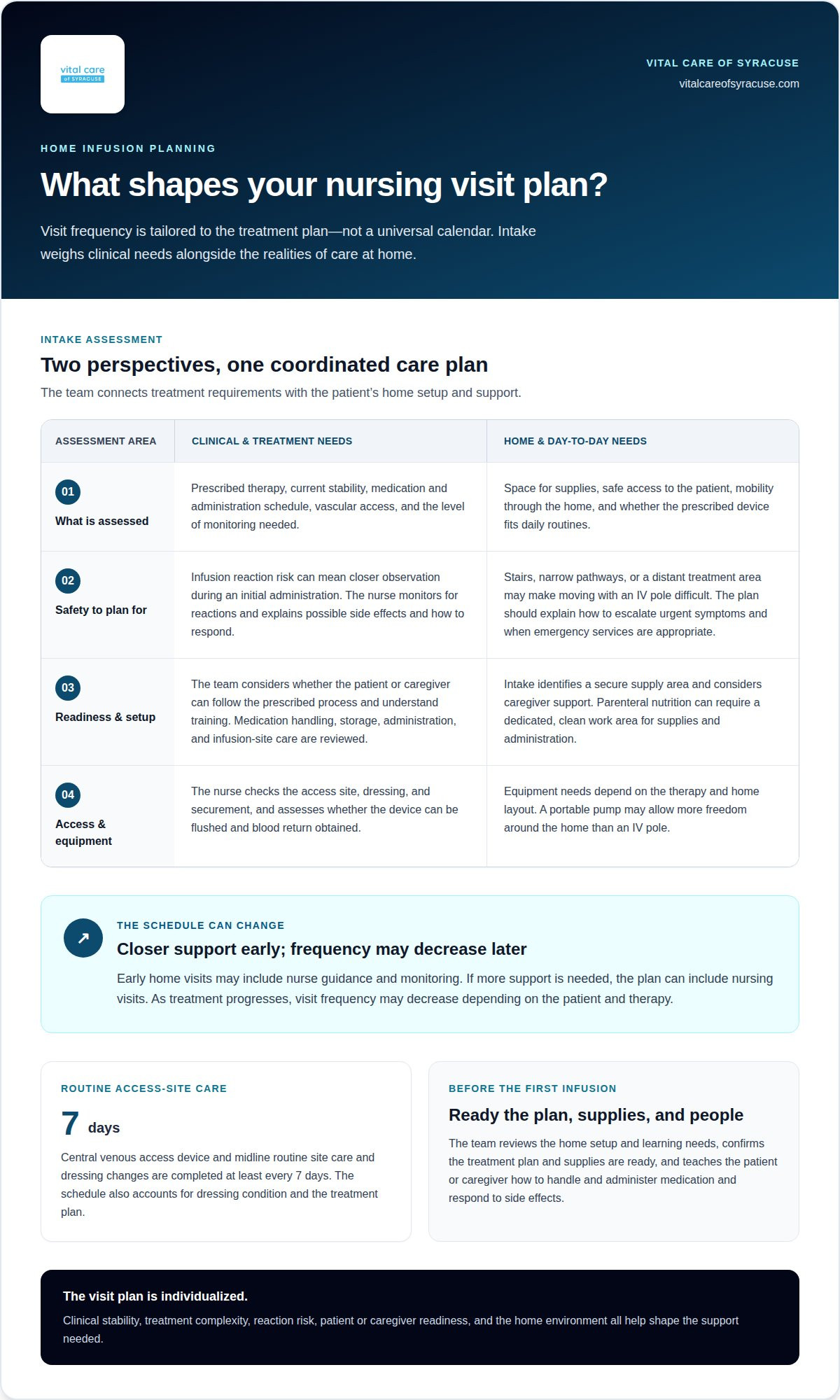
Home infusion suitability depends on the prescribed treatment, the member’s needs, and the home setting. Assessment should identify who can manage each task and what support would make the plan workable.
- Review the treatment plan. Confirm the therapy, schedule, and equipment needs so the home routine can be planned around them.
- Identify the member’s support needs. Discuss which tasks the member can manage and where a caregiver or nurse must assist.
- Clarify caregiver responsibilities. Agree who will help with setup, observe for changes, and communicate concerns to the care team.
- Consider the daily routine. Map treatment times against meals, rest, and other responsibilities to spot practical conflicts before care begins.
- Prepare a clean, safe work area. Choose a clear surface for supplies, remove clutter, and keep pets away during setup and treatment.
- Check the surrounding space. Keep walkways clear and secure tubing or cords to reduce tripping hazards while the member moves around.
- Discuss equipment and access. Identify where devices will be used and whether the member can reach supplies without unsafe stretching or lifting.
- Plan how questions will be raised. Make sure the member and caregiver know whom to contact about clinical, scheduling, medication, or equipment concerns.
- Include changes in condition in follow-up. The team can use updates to review whether the existing routine and support remain suitable.
A nurse demonstrates how to set up the home infusion system. Use that teaching to walk through the actual space, supplies, and sequence planned for treatment. If a step is difficult to perform safely, discuss the obstacle with the care team before relying on that routine. A clear assessment connects the member’s abilities, caregiver support, treatment demands, and home environment in a practical plan.
Peripheral catheter placement and venipuncture limits
In home infusion, medicines or fluids enter a vein through a flexible catheter, usually placed in the arm or chest. For peripheral catheter placement in home care, the recommended limit is no more than two attempts per nurse and no more than four attempts total. Tracking attempts makes these limits clear across the care team.
- Confirm the access plan before placement. Knowing whether treatment uses a peripheral catheter helps the team follow the correct placement plan.
- Count each nurse’s attempts. The recommended maximum is two attempts per nurse, so the count should stay clear if care changes hands.
- Track the total attempts. The recommended maximum is four attempts overall, including attempts by different nurses.
- Pause when a limit is reached. A nurse who reaches two attempts should not exceed that recommended limit; the team can coordinate next steps.
- Share the attempt count during handoffs. Communicating the number already made helps another nurse track the overall four-attempt limit.
- Record what happened. Note the attempt count and any difficulty, so the next care-team discussion starts with accurate details.
For example, if one nurse makes two attempts, a second nurse should know the count before proceeding. The overall limit remains four attempts, not four additional attempts per nurse. Clear communication prevents the per-nurse recommendation from being mistaken for a new total allowance.
Keep the member informed about the plan and explain any pause in plain language. If placement reaches the recommended limit, communicate the count to the clinical team before further attempts. This gives the team a shared, specific point for coordinating care rather than relying on memory or assumptions.
Use these attempt limits as one part of the home infusion safety checklist. For help coordinating home infusion care, explore home infusion support.
Hang the bag or bottle above the IV catheter level so gravity can help the medicine or fluid flow into the tubing. Families should plan for power outages, extreme weather, evacuations, shelter-in-place situations, transportation barriers, medication storage, and essential medical equipment needs.
Vital Care of Syracuse: Home infusion
Vital Care of Syracuse provides home infusion for patients whose prescribed treatment can be delivered at home. Its offerings include Anti-infective Therapy, Immunoglobulin (IVIG/SCIG), and Parenteral Nutrition (TPN). Because these therapies have different routines and clinical needs, the care plan should clearly define the treatment, schedule, supplies, and care-team responsibilities.
Consider home infusion when a treating clinician has prescribed infusion therapy and the care team is coordinating a home-based plan. Discuss questions about access-site care, treatment routines, equipment, or communication as part of that planning. Clear instructions help members and caregivers understand their role in treatment.
Contact Vital Care of Syracuse to discuss home infusion and your prescribed therapy.
Make your next care conversation count
As treatment moves into the home, the care plan should remain a practical guide, not just instructions filed away. Use your home infusion safety checklist to note questions that arise during daily routines, such as unclear steps or difficulties with preparation. Bring those observations to the care team so instructions can be discussed in the context of daily life.
Small updates can help keep the member, caregiver, and clinical team aligned as needs change. A written note about a concern, a new challenge, or a helpful adjustment gives everyone a clearer starting point for discussion. Ongoing communication can make it easier to approach home treatment with confidence and care.
If you’d like to discuss home infusion, contact Vital Care of Syracuse. Take the next step at a pace that feels manageable, with your care questions ready.
Frequently Asked Questions
What should be on a home infusion safety checklist?
A useful home infusion safety checklist brings treatment details and household plans together in one accessible place. Include the current medication record, allergies, emergency and care-team contacts, upcoming appointments, equipment instructions, and a backup plan for essential equipment during power outages. Keep the information available to the member and caregiver, and update it when medication or care-plan details change.
How do you inspect and care for a PICC line, port, or other infusion catheter at home?
Follow the instructions taught for the specific catheter, since care steps depend on the access device and treatment plan. During routine checks, note any changes in the surrounding skin or the member’s comfort, and record when they began. If a step is unclear or the device looks different from the nurse’s demonstration, pause and contact the clinical team rather than improvising.
What home infusion safety requirements and patient training standards apply in the United States?
Home infusion suitability depends on the prescribed medication, diagnosis, and clinical considerations determined by the patient’s healthcare provider. Training should match the treatment and equipment used at home, including setup, the care plan, and how to respond to device instructions. Vital Care of Syracuse provides home infusion when clinically appropriate, with professional supervision and caregiver training.
Leave a Reply